

Try it on Backwards
Shuffling your scenes to revitalize your story.

This is about stories and novels, really.
Pardon me while I geek out a bit, but I do believe that studying different arts really feeds our own. I’m a huge fan of musical theater and Stephen Sondheim, and even if you aren’t bear with me, this is about storytelling and order.
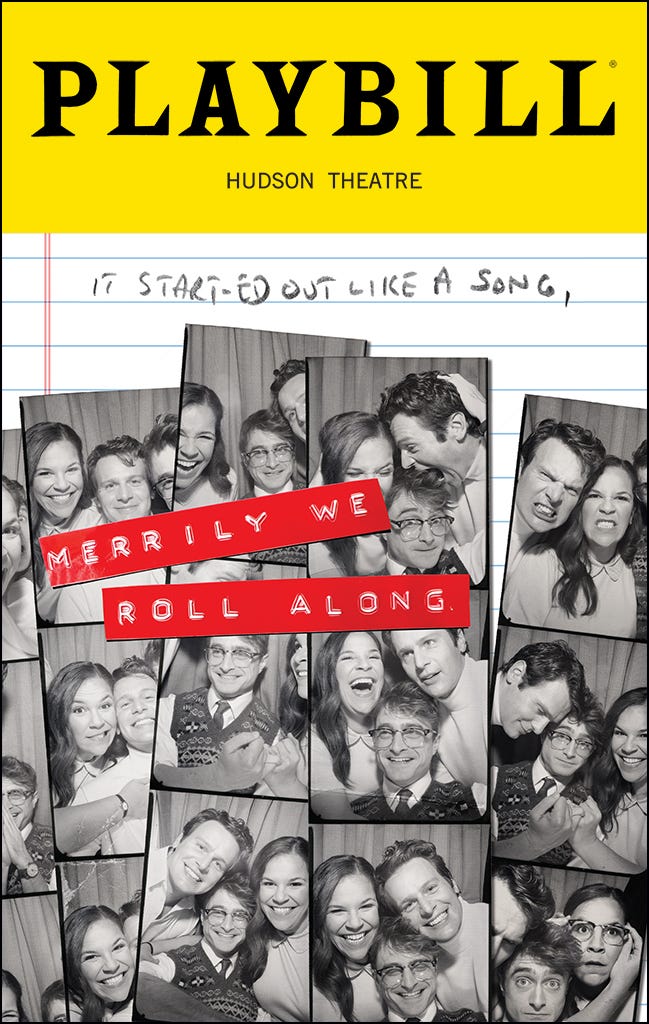
On Sunday my daughter and I went to see a movie theater viewing of the Broadway musical Merrily We Roll Along starring Jonathan Groff, Daniel Radcliffe, Lindsay Mendez and the fabulous Crystal Joy Brown, who held her own through some difficult songs and carried off an unforgiving role with brilliance.
The musical premiered in 1981 and my parents, huge Sondheim fans hot off Sweeney Todd came home from the show disappointed, saying it was “a huge bummer.” Merrily We Roll Along tells the story of three writer best friends from their young scrapping days in New York, through their breakthroughs in their fields (Mary is a novelist, Frank writes music, Charlie lyrics and plays), to their inevitable betrayals and separation. Frank, the main character chooses fame over loyalty, fame over friendship and wife after wife after wife.
My daughter and I were talking about how Sondheim’s second acts (aside from Sweeney Todd) are often a slog and don’t always work pacingwise and wondered at how this version of this bummer play would do the same.
Turns out it wasn’t a bummer at all. The producers had reimagined the play entirely.
This version, which was a huge hit on Broadway, rejiggered the entire play and tells it BACKWARDS.
This changed everything. And this bummer, this slog, is actually a brilliant, moving, character driven story that creates nostalgia for the audience in unexpected ways. What were reprises of specific songs in the prior version are now sung first so that the second iteration of the song, less dramatic, creates a brilliant echo, and elicited some awwws and ohhhs in both the movie theater audience and recorded stage audience. We learn that a heart wrenching song sung by Frank’s first wife Beth upon their divorce was first sung on their wedding day with a completely different sentiment (and in a duet with Mary, heartbroken on that day), and it wrecks us. We learn that a quote Frank gives the press that seems hackneyed is actually a heartfelt line said by Charlie back when they were writing partners and enthralled and energized by their collaboration. We see Mary, a furious frustrated alcoholic at the beginning of the show, go back through time to the turning point where she started to drink, from hopelessness into hope, from being betrayed by her friend into love and friendship. We see Joe, an impoverished ex-producer who hung outside a studio to bum money off his wife go backwards in time to when he was a success and created a huge turning point for Charlie and Frank. This makes Frank’s betrayal of Joe by throwing him over when he’s too big for him and stealing his wife hit harder. And, that tired path plodding trope of fame killing someone’s soul and making them betray their friends, now becomes the audience asking all the way through the story, “How did they get here? How were they ever friends?” We go back through time year by year, and now, the friends’ first meeting in their young life in a rooftop in New York becomes extraordinarily wistful, as we see them starry eyed with hope and wonder and because we know where the friendship ends up, it becomes gut wrenching. The play is not only fixed, it is enhanced and made more meaningful for its audience through its newly energized emotional progressions.
I had this musical running through my mind yesterday as I did my regular bike ride backwards (it wasn’t that deep, I wanted to see the launch of the Santa 10K which my family was running, so I went through the park and up the bike path instead of the reverse). A tunnel I usually bomb through, with my eye on the horizon and downtown LA, graffiti invisible due to the reflection off the river, became visible as I pedaled more slowly uphill. These beautiful paintings I’d never noticed before came into view.
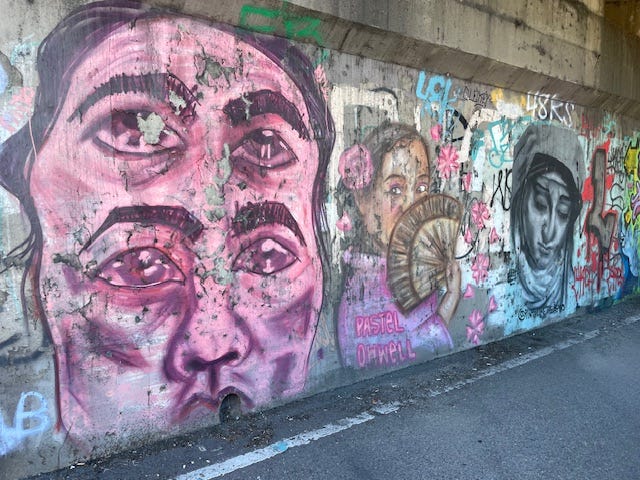
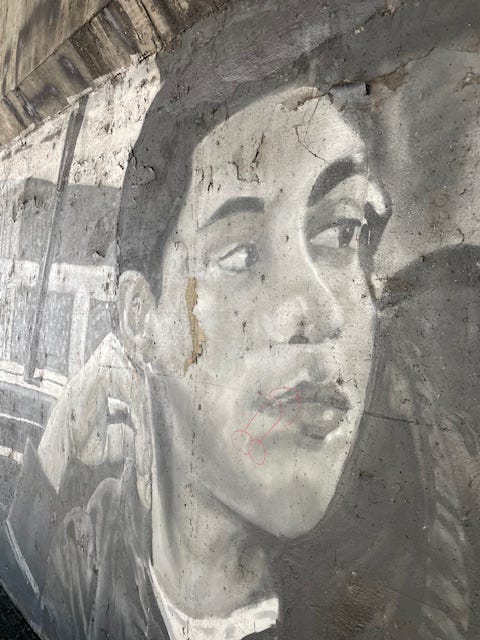
And, in those eureka moments we have every so often as writers, it only hammered home this idea, that if we can look at our work (novels, stories) out of order, and take time to rethink the story, something beautiful can be revealed, and maybe something that was there in our writing all along.
I always tell writers I work with and my students that your novel, even your short story, is a moveable feast. If you index card your scenes (I walk you through it in a teaser for a Crystal Lake Academy class I teach here—and below) you can rearrange them for maximum impact. The rearrangement on this musical was such an enormous success, completely switching up the energy of the entire story, that it has reenergized my belief in that rearrangeability of any story.
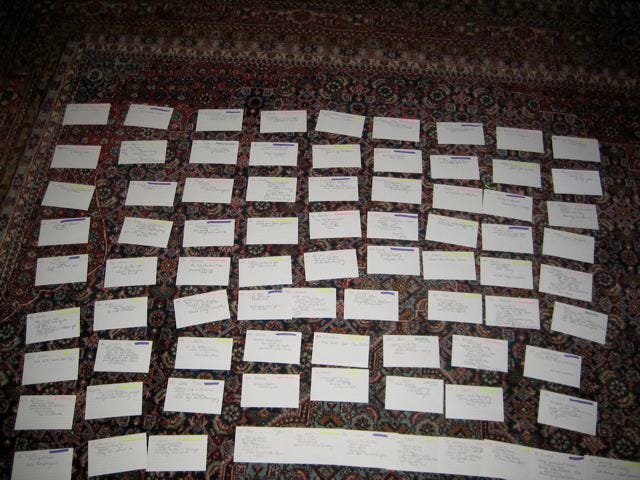
So if your novel or story has dead spots, or you feel like it’s getting too and then, and then, and then—write down the heart of each scene, its dramatic pull, onto index cards (yes I know Scrivener has this function, I believe that having to figure out at its core what each of your scenes is about is part of this ReVision exercise, so try it with a good old fashioned pen and 99c store index cards).
Writing down what each scene is at its heart puts the whole story in your head. Then lay the cards out in the order they are written into the book or story and simply start to rearrange them. What if that scene in the middle actually came first? What if that slower scene were moved to right after a dramatic one? Once you find a better order, you’ll want to make sure your transitional sentences at the beginning of each sentence anchor us in time and place. You can then go through for dramatic impact. How has this reorder affected the progression of emotion of the piece? Are there things you can do to amp up the new energy you’ve just created? (I promise you have definitely created new energy). And you may just find you have some extraneous scenes that can go (a bunch was cut from the original of Merrily We Roll Along).
I also use index carding when I have a bunch of pages that aren’t totally a draft. I write down the scenes I have and then in a different color index cards, I write down the scenes I have yet to write, rearrange and insert them. It’s simply another way to get a handle on your story.
As to a short story, instead of index carding, I’ll print the story out, and cut it into paragraphs, or sentences when I’m uncertain of the progression, and rearrange it to see what I have and how the progression of the story works. This is all an exercise in discovering what your story has hidden from you, but already has working in it.
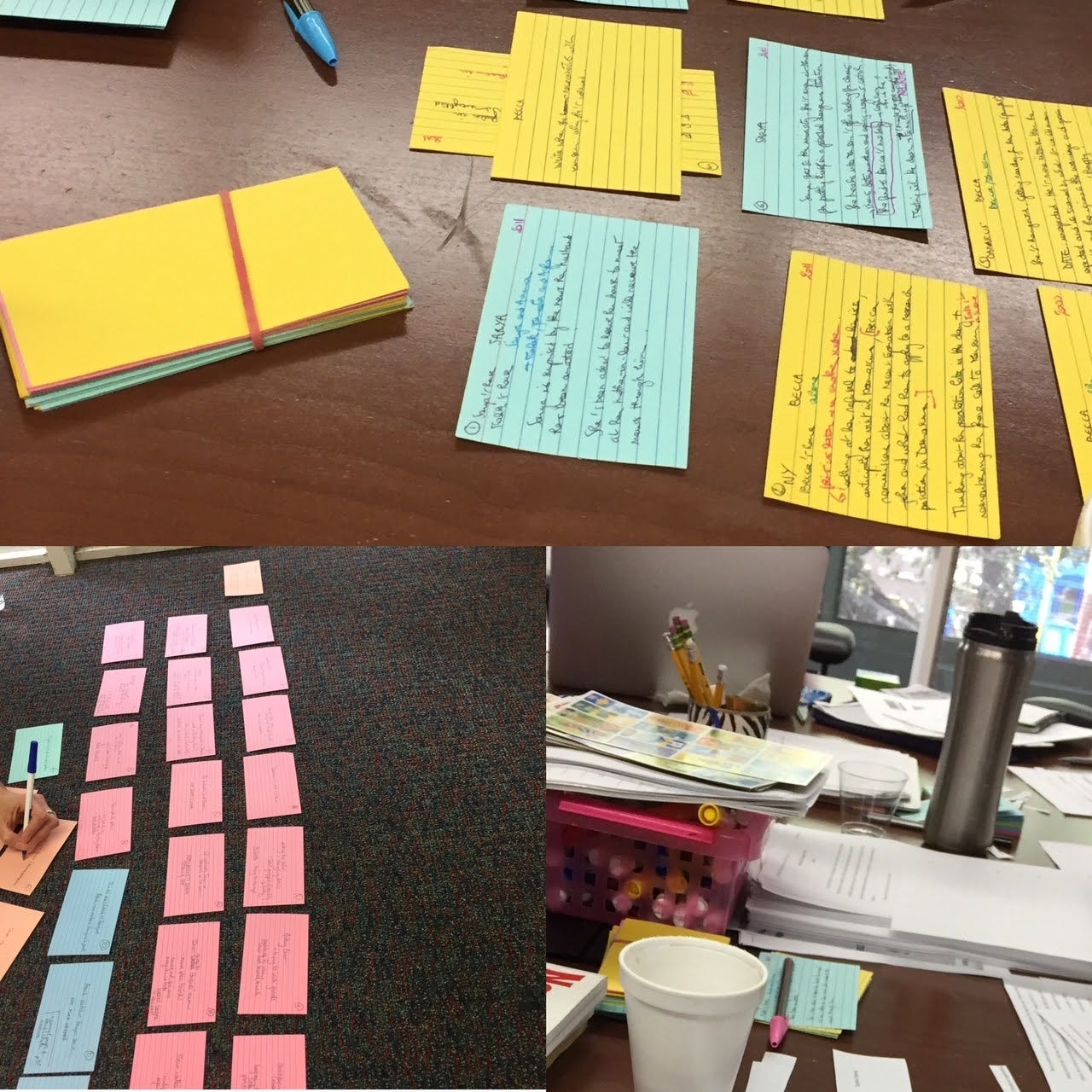
Feel free to dive in and have fun with this (scissors! Tape! Index cards!), maybe revitalize a story that’s been sitting on your desktop just kinda meh, not ready for anyone. And please let me know how it goes!
This was inspiring! Great newsletter!
Thanks, Kate! This is such a helpful post! 💗